Thursday, October 13, 2016

Field Post 1: Noble Observations

Upon walking into Noble Elementary School, all of my senses heightened and I observed everything with great detail. I noticed the physical aspects of the building, such as the single blue wall and the four windows in the room I was observing. I also noticed what was happening in the rooms themselves. I noticed who was talking and who was responding, I noticed the characteristics that the children were presenting, and I noticed the different learning styles that were being used. 

I decided to focus on one child in particular, named Jack. Jack was very excited about learning; his hand would shoot up every time the teacher would ask a question. He was constantly fidgeting and playing with his shirt, bringing it up over his mouth and biting the collar. He would also tap his pencil on his desk and cheek, and bite on the ends when we was told to be quiet. 

I found it interesting how much Jack, as well as the other students, felt the need to constantly be moving. In fact, in the middle of the lesson the teacher let the students have a five minute dance break. The students were more focused on learning after they had a chance to move around and dispel some of the left-over energy from their bodies. 

The biggest thing that I discovered about myself was how closed-minded I had been going into our site visits. I had never stepped foot in a public school before and I had so many predisposed thoughts on what it would be like. I thought I was going to hate the experience and that it was going to be a huge reality shock for me. I was pleasantly surprised after my first visit, though, and I may even consider teaching at a public school one day. 


Wednesday, September 28, 2016

Blog Post Week 3: A Voyage of Discovery and Surprise

“Teaching at its best is not a matter of technique -- it’s primarily an act of love.”

The first few passages from To Teach the Journey, in Comics tells us to think of ourselves as explorers on a journey with our students. We have the constant opportunity to grow from our experiences with our students and the ability to offer them the same thing. We can use our passions to help students learn and grow, and we can use their passions to enhance the learning experience.

There are also several popular “myths” that we must work to debunk. These include: teachers always knowing what’s going on in the classroom, a teacher’s primary work is “saving” the children, good teachers are good performers, and good teachers always know the material. Teachers should constantly be evolving, just as classrooms are constantly changing and students are developing.

In order to find your way as a teacher, you must first find out who YOU are. When we have a strong sense of personal identity, it will shine through in our teaching and encourage our students to do the same.

Teachers should not label students or focus on the “problems” that they can’t fix, rather they should focus on the things that they can do for their students. As teachers, we should be willing to adapt and learn alongside and with the students in our classroom.

My question is: How does a teacher convey their passion as an act of love and how do students benefit from this?


Thursday, September 15, 2016

Blog Post 2: Living Up to the Impossible Standards Set by Miss Honey

Why teach? 

There are a million ways one could go about answering this question. 

So, of course, I will be going in a completely different direction with this topic. 

Image result for miss honey gif

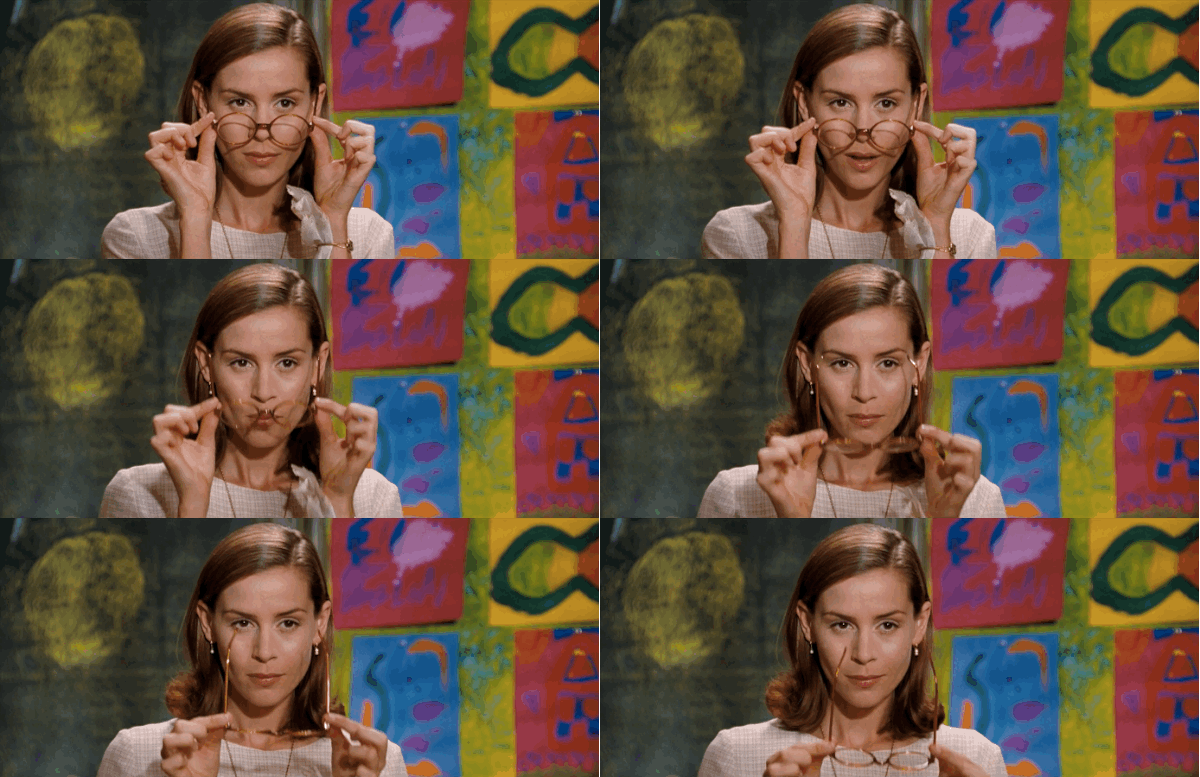
"Miss Jennifer Honey was a mild and quiet person who never raised her voice and was seldom seen to smile, but there is no doubt she possessed that rare gift for being adored by every small child under her care." - Matilda

Most people are familiar with the story of Matilda by Roald Dalh. Ever since I first saw the movie and read the book as a small child, I knew that I wanted to grow up to be a teacher like Miss Honey.

Miss Honey takes a special interest in all of her students, especially Matilda. She sees each child's abilities for what they are: incredible. She believes so strongly in her students, even when no one else does. She does not run away from the creativity of her children, and she does not let the education system dim her imagination. Miss Honey supports her students and does everything in her power to encourage them. 

I think the most important and biggest characteristic trait of Miss Honey is that she becomes a friend for her students, as well as a trusted adviser. 

I believe that all teachers and hopeful teachers should aspire to be like Miss Honey. 

Why teach? Ask Miss Honey. 

WebPost1: Class Survey

Hello everyone! My name is Ashley Cantor and I am a commuter student from Akron, Ohio. I am an AYA Education and History major. My hope is to one day teach history and coach girls soccer at a Catholic high school. 

Here are a few fun facts about myself: I have red hair, I can do a cartwheel, I am an avid coffee-drinker, and I believe full moons are overrated -- crescent moons are where it's at.

Other interests include: binge watching Netflix, reading, listening to music, playing saxophone, and singing. 

This semester I hope to become an active member of campus. I plan on rushing a sorority, joining a Carroll Faith Community, and getting involved with Campus Ministry. 

Family is the most important aspect of my life. Please click HERE to view the article "Family Routines and Rituals May Improve Family Relationships and Health, According to 50-Year Research Review." I have been blessed with a family that has always been a very active part of my life. I believe that family is important for children's health and development, as well as the health and well-being of adults. Our families help to form us into the people we are today, and have a main role in defining our relationships with others.

In order for me to feel comfortable in the classroom environment, there needs to be a healthy, community environment present. I believe that trust is a very important component in the classroom. If students feel like they can collaborate together, speak freely, and have open minds in regards to the learning process, they will be more likely to succeed. 

Although I did rather poorly in my high school AP Physics classes, they helped me grow significantly as a person and pushed me to realize that teaching is, in fact, what I want to do for the rest of my life. My teacher did an excellent job trying to find new ways to present the course material to students so they would be able to better understand the information. My biggest takeaway from my physics classes were not related to the subject itself. I learned that it is completely normal and acceptable to fail in the classroom and in life. Our class was always told "Ever tried. Ever failed. No matter. Try Again. Fail again. Fail better."

I think the lack of willingness to experiment with new and unique teaching methods is one of the biggest problems in the field of education. In order for students to succeed, as well as feel comfortable and confident in the classroom, teachers must be willing to adapt with the ever-changing environments they are thrown into. 

Dr. Shutkin, what do you want to be when you grow up?